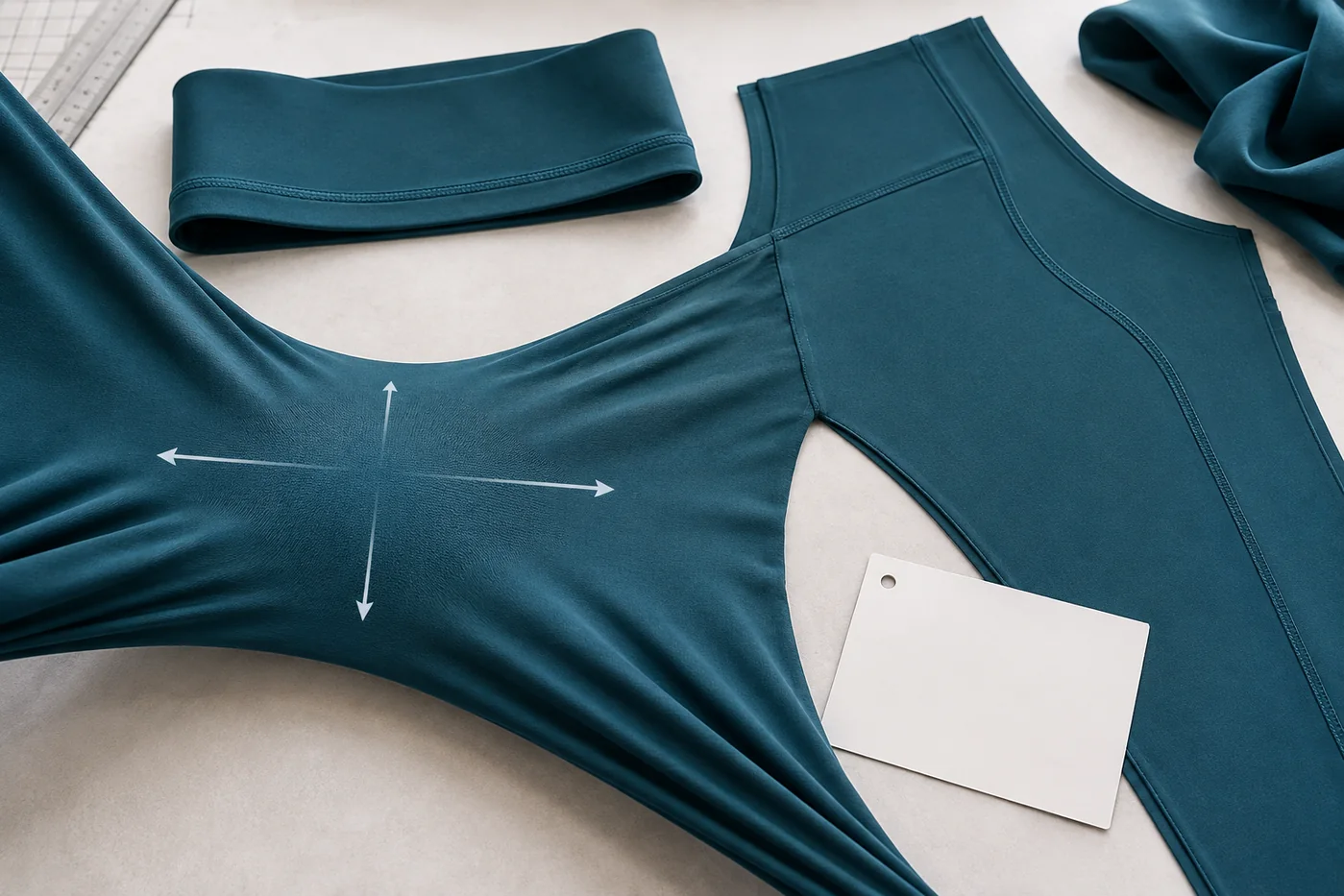
Four-Way Stretch Is Not Four Equal Directions
A knit may extend in length and width while still having different force and recovery in each direction. That difference influences rise, waistband stability, leg length and how the garment follows movement.
Measure extension and recovery in wale and course directions using an agreed method. Keep the approved fabric orientation on the marker and technical file.
Match Fabric Force to Pattern Reduction
Legging patterns are commonly smaller than body measurements, but the correct reduction depends on fabric force and the intended compression. Reusing one pattern across fabrics can create rolling waistbands, restriction or loose knees.
Fit the base size on the target body and record actual garment measurements. Adjust pattern and fabric as one system rather than treating stretch as a universal correction.
Test Opacity at Real Extension
Opacity must be checked at the extension created by the selected size and movement. A swatch held loosely over a light box does not reproduce the stress at the seat, thigh and gusset during a squat.
Test every launch color and inspect pocket bags, labels and seam allowances. Pale shades and heather surfaces may require a different density or liner strategy.
Protect Recovery Through Production
Heat setting, dyeing, brushing, pressing and repeated needle penetration can affect elastane. Approve the actual finished fabric and control pressing temperature during sewing and branding.
Wash and repeatedly extend the sample before reviewing knee bagging, waistband movement and seam appearance. Initial fit alone does not prove durable recovery.
Write a Fabric-and-Fit Approval
Keep composition, GSM, width, stretch, recovery, opacity, colorfastness and dimensional-change results with the pattern version and fit-model measurements.
When requesting development, provide activity, coverage, compression, waistband route, size range, colors and target quantity so the manufacturer can propose an appropriate knit.
Relevant Product Program
Yoga Wear Manufacturing · Low MOQ Activewear · Fabric Performance Guides
Discuss Your Fabric Requirements
Share the product category, target quantity, fabric direction, performance claim, colors, care route and destination market with CCLIYA.
Request an OEM or ODM Quote