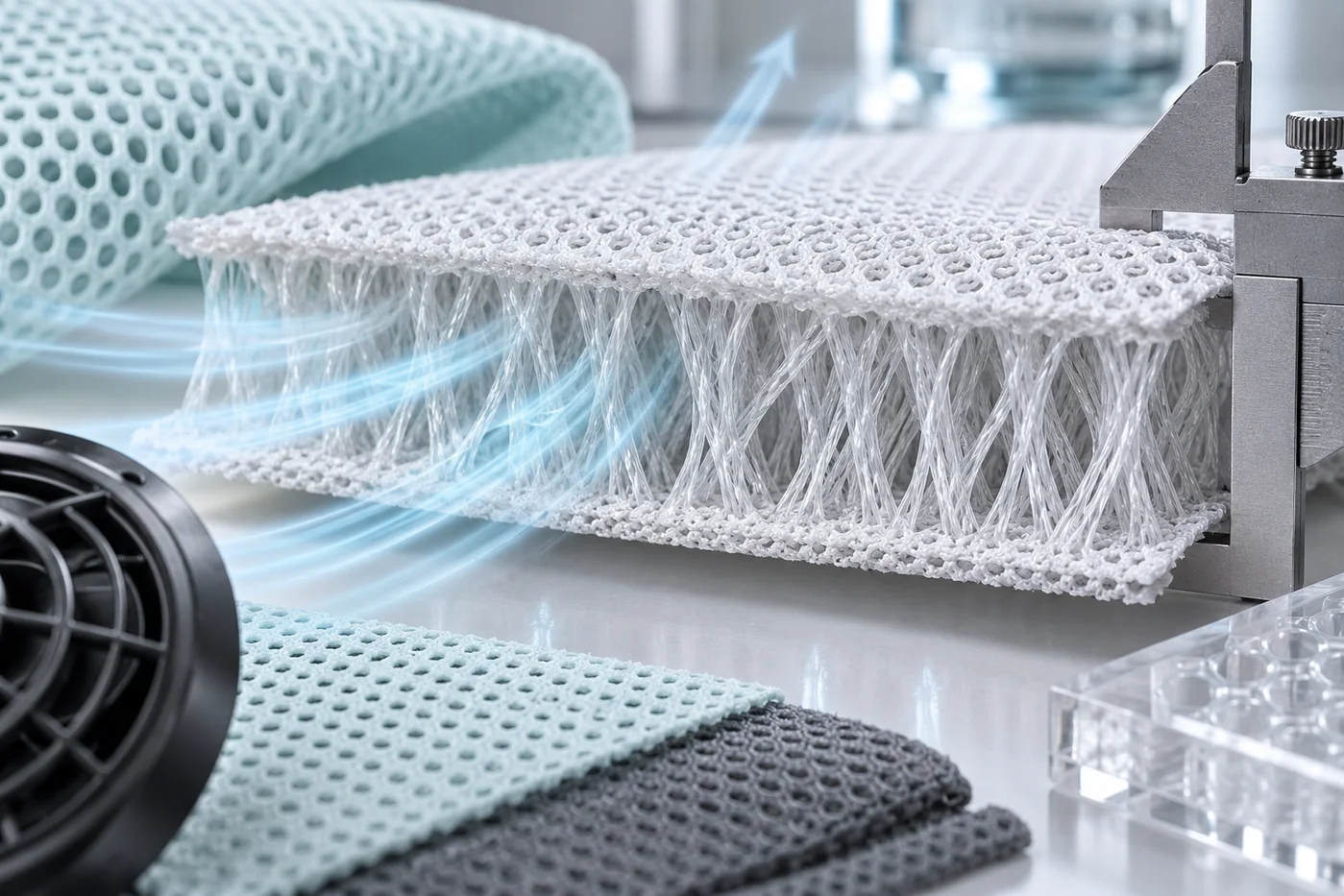
How Spacer Mesh Is Built
Three-dimensional spacer mesh has two knitted faces held apart by connecting yarns. The internal space can support airflow, resilience and lightweight cushioning without using a solid foam sheet.
Specify face construction, thickness, weight, width and fiber content. Materials that look similar in a photo can differ greatly in stiffness and compression.
Define the Functional Requirement
Spacer mesh may be used in bra inserts, backpack-contact zones, cycling components, protective panels or structured ventilation areas. Each application requires a different balance of cushioning, breathability and flexibility.
State whether the material must recover after compression, bend around the body, drain water or resist repeated rubbing. This narrows the suitable construction.
Evaluate Airflow and Heat
An open surface does not guarantee comfortable airflow when the material is laminated or covered. Test the final layered assembly and consider whether body pressure closes the air channels during use.
Thickness can hold warm air as well as create ventilation space. Wear testing in the intended climate is useful when thermal comfort is a key promise.
Plan Cutting and Edge Finishing
Cut edges can expose spacer filaments and create bulk. Evaluate binding, enclosed seams, ultrasonic cutting or other suitable finishing routes with the exact material.
Needle choice, seam allowance and compression under the presser foot affect consistency. Thick panels may require different construction than the surrounding jersey.
Test Compression and Care
Measure thickness and recovery before and after repeated compression. Inspect face abrasion, delamination where used, trapped moisture and deformation after washing and drying.
Send the panel location, required thickness, loading, wash route, color and quantity to the supplier. Approve the finished component, not only a loose spacer-mesh swatch.
Relevant Product Program
Custom Activewear Manufacturing · Low MOQ Activewear · Fabric Performance Guides
Discuss Your Fabric Requirements
Share the product category, target quantity, fabric direction, performance claim, colors, care route and destination market with CCLIYA.
Request an OEM or ODM Quote